Friday, February 24, 2012

Nyotaimori

"Map of the Sounds of Tokyo" is a Spanish movie, but you wouldn't know it (when watching it) if you were not told. You'd think it's a Japanese movie. This film is by director Isabel Coixet and the movie is a thriller, but it starts with a definitely eyebrow raising feast called "Nyotaimori" that caught my attention. Feminists cringe and protest in drove because of the practice of eating hot sushi out of a woman's naked body. They do not care much if that is sometimes the price of doing business in Japan or copy cat in other countries simply for the fun of it. Columnist Julie Bindel of The Guardian, in February 2010 paid 250 English pounds to attend a real Nyotaimori in London and wrote an article about it. Needless to say, she despised it!

According to Jack Herbert, this is how "Body Sushi" is done:

"Before becoming a living sushi platter, the person (usually a woman) is trained to lie down for hours without moving. She or he must also be able to withstand the prolonged exposure to the cold food. Before service, the individual is supposed to have taken a bath using a special fragrance-free soap and then finished off with a splash of cold water to cool the body down somewhat for the sushi. In some parts of the world, in order to comply with sanitation laws, there must be a layer of plastic or other material between the sushi and the body of the woman or man."

Watch this clip and let me know if you would participate in such a feast. Not me! I think this movie was a financial loss. It was produced at a cost of US $8 Million dollars but only grossed about $3 millions. I think the Japanese tint of this movie did not fare well with the Spanish movie viewers.
The Way to Calvary

Monday, February 20, 2012

HTML5 Music Player

While talking about the tree of death... let me follow that somber thought to test a new music player to take place of my now aging Flash music player... So let's take a little detour to listen to the beautiful music by Wolfgang Amadeus Mozart, his Requiem.
Mozart's Requiem

Sunday, February 19, 2012

Life and Death

This is the third and last clip from the movie "The Mill and the Cross." In this clip, the painter, Pieter Bruegel, explains the composition of his famous painting. It contrasts life (the left half of the painting) to death (the right half of it.) The crows perched atop the wagon wheel on the trees of death and the ones flying in the sky are birds of prey that feed on the dead. This movie has scenes of that and I thought are too gruesome to include them in this blog. All famous paintings from the ancient masters have stories to tell. What does La Gioconda tell you? Do you know? She was Lisa Gherardini, wife of Francesco del Giocondo... A very interesting story to tell there.
The Way to Calvary

Thursday, February 16, 2012

The Tree of Death

You have seen the first clip from The Mill and the Cross. Are you ready for a second clip of that movie? A mild warning to you that this second clip is a bit hard to watch due to some violence, especially that if you watch the clip closely, you will see that the man being severely mistreated execution style is an innocent man. He was killed nonetheless! This clip is necessary for me to show you the meaning of the tall pole with a wagon wheel on top in the extreme right of the "The Way to Calvary" painting. Please pay attention to the first minute of the clip as it provides clues to understand how that painting was created. In a few days, you will see the third and last clip of this movie that contains in some details how this painting came to life... Come back if you have time...
Mill and Cross

Monday, February 13, 2012

Wind Mill

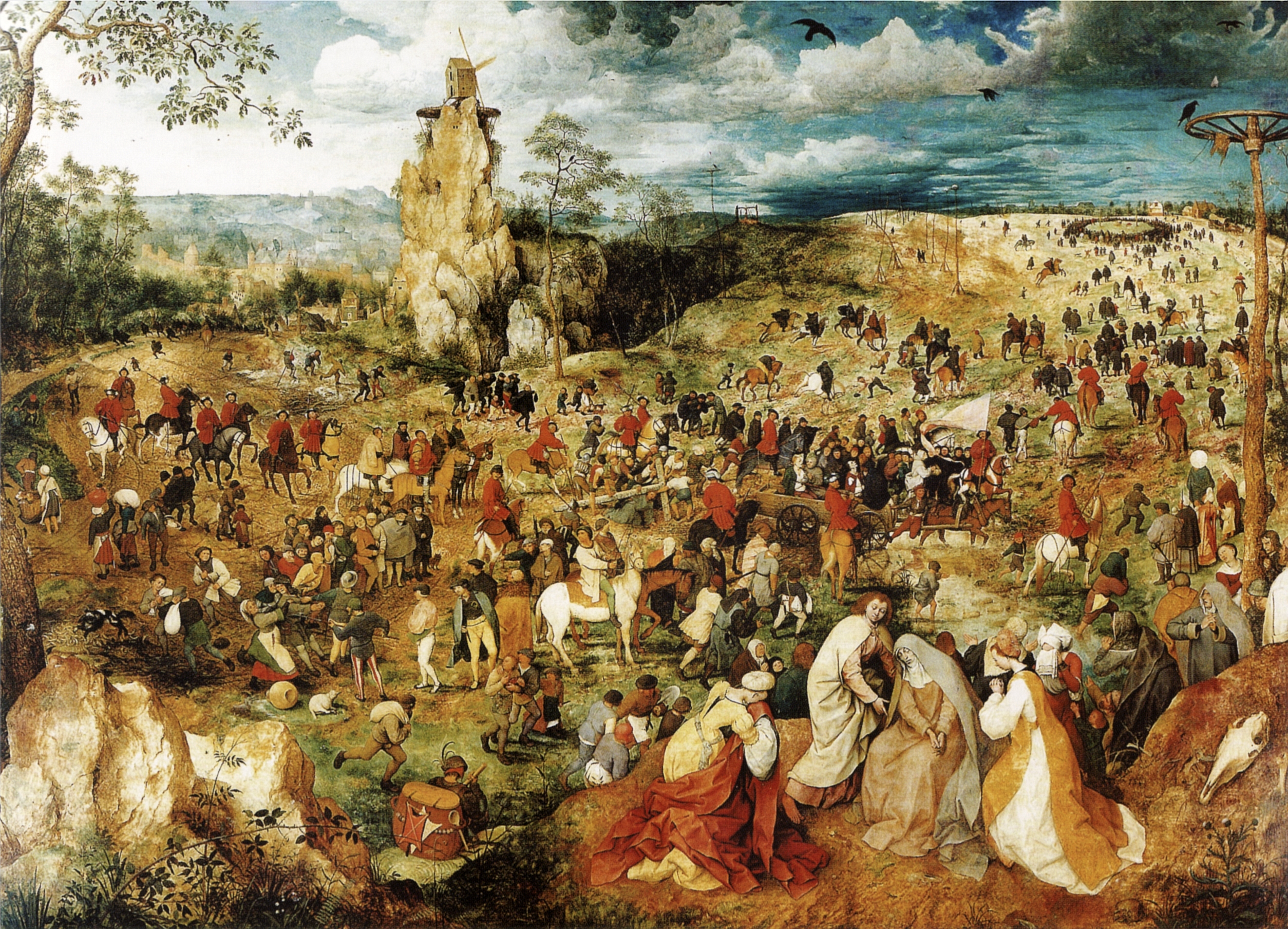
The US makes about 2,500 new movies each year! You'd think that it should be easy to find good material for a movie blog. Nothing is further from the truth! Many times, at least for my taste, I need to reach back to years bygone to find movies worth talking about. It is interesting to note that many foreign movies, movies made from countries other than the US, are excellent proofs that one does not need budgets in the hundred millions of US dollars to make good movies. Here is one that fits such bill: Lech Majewski's 2011 Polish-Swedish co-production "The Mill and the Cross." This movie was recently made with a meager 1.1 Million Euros and it premiered at the Sundance Film Festival in January 23, 2011. It focuses on a dozen of the 500 characters depicted in a famous Pieter Bruegel's 1564 painting "The Way to Calvary" that sets against religious persecution of Flanders' Protestants in 1564 by Spain's Catholics.

As way of background for you, here is The Way to Calvary as it is displayed in the Kunsthistorisches Museum in Vienna:
The Way to Calvary
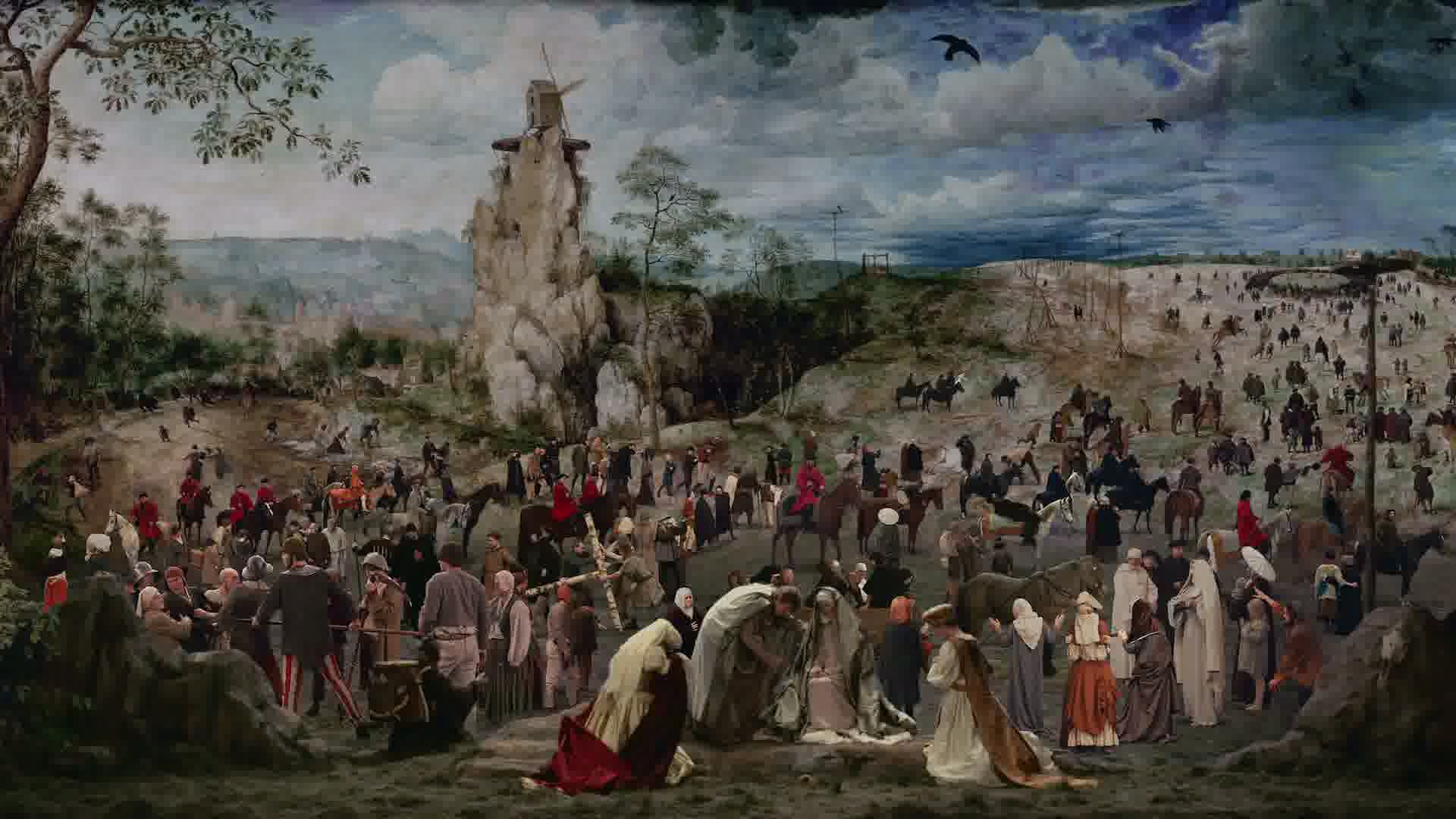
This film painstakingly recreates the painting with live persons, using blue screen technique and computer graphics to immerse the viewers into the painting that comes alive. In this movie, the actor portraying the painter provides detailed explanations to his work of art, at the same time giving a historical depiction of 16th century life in Flanders. There is a couple of scenes that are quite disturbing due to the senseless violence during persecution scenes. You will see one in the next blog following this one. Come back here in a few days...

This blog shows you the cinematic interpretation of life inside a wind mill as seen through the eyes of the movie director Lech Majewski. What is remarkable is the opening sequence that slowly morphs live action shots to a digital still life painting that looks like this:
Super

Click here to see the video clip.

Sunday, January 29, 2012

Hedgehogs and Foxes

I hesitated, but what the heck... let's embark on a theme that is almost universally found in movies... not only American movies, but worldwide in international films, and that is love and sex. However, I am not so sure how daring I can be to approach the many movies that are very very saucy... the likes of Fatal Attraction, Basic Instinct or even In the Realm of the Senses... That is to be decided as we go along in this blog. To begin, let's talk about... the Hedgehogs and the Foxes.

In way of background, I think I should mention in passing that it helps to have some background of Darwin's work and if you are philosophical in nature, you'll feel right at home here. You may also want to look up a subject named "The Botany of Desire." Yes, all the aforementioned have something to do with love and sex... and orgasm.

In movies, I'd say Woody Allen is the best director who can approach sex and love (and also death) with panache and at the same time, he educates the mass with deep philosophical thinking that easily get lost for the casual movie watchers. Take his Husbands and Wives (1992,) a famous scene from which much have been talked about and analyzed in depth by many scholars at many famous learning institutions. The real subject under consideration was anorgasmia. You know that in medical parlance, many nouns that terminate with the suffix "mia" are bad for you: anemia, leukemia, arrhythmia... The prefix "a" says that something is missing. So "anorgasmia" must be bad for you because that says you cannot experience orgasm. That's a major theme in this Allen's movie. Why don't you watch this clip first.. then we'll talk when you return...
Super
Well, what did you get from the clip? Let's make sure you got it by dotting the i's and crossing the t's: The movie revolves around two married couples: Jack (Sydney Pollack) and Sally (Judy Davis;) and Judy (Mia Farrow... did you notice that? Mia is a bad omen as a name, medically speaking as explained above) and Gabe (Woody Allen.) Sally and Jack separated and took on new lovers, Jack with Sam (Lysette Anthony) and Sally with Michael (Liam Neeson.) The scene is when Michael was finally able to convince Sally and take her to bed. This is when you realize that she is anorgasmia, from a session with her psychiatrist, when she confesses her continued frigidity while with her husband Jack. What you hear in the clip is her infamous "hedgehogs and foxes" analysis. She was asked: "Why were you able to have an orgasm with Michael and not with your husband?...What makes it so difficult for you?" Her answer was:

"I didn't. I was trying very hard to go with it. I was tense. I came close... (She lied, she was nowhere close!) My mind just gets racing with thoughts. You'd laugh if I told you. I get so mentally hyperactive....I thought that I liked what Michael was doing to me, and it felt different from Jack. More gentle and more exciting. And I thought how different Michael was from Jack. How much deeper his vision of life was. And I thought Michael was a hedgehog and Jack was a fox. And then I thought Judy was a fox, and Gabe was a hedgehog. And I thought about all the people I knew, and which were hedgehogs, and which were foxes. Al Simon, a friend, was a hedgehog, and his wife Jenny was a hedgehog. And Cindy Salkind was a fox. And Lou Patrino was a hedgehog..."

It is the writing for scenes like this that this movie was called a "philosophical film." The "Hedgehog and the Fox" is a famous and popular essay by the liberal philosopher Isaiah Berlin. The title is a reference to a fragment attributed to the ancient Greek poet Archilochus: "The fox knows many things, but the hedgehog knows one big thing." Berlin expands upon the original idea and divides writers and thinkers into two categories: hedgehogs, who view the world through the lens of a single defining idea: Plato, Lucretius, Dante, Pascal, Hegel, Dostoevsky, Nietzsche, Ibsen, and Proust; and foxes who draw on a wide variety of experiences and for whom the world cannot be boiled down to a single idea: Herodotus, Aristotle, Erasmus, Shakespeare, Montaigne, Molière, Goethe, Pushkin, Balzac, Joyce, Anderson. Tolstoy, was considered different. He had multiple talents like a fox, but was a giant thinker that qualifies him as a hedgehog.

With that as a background... Many a discussions I found about this scene immediately delved deeply into the philosophy of thinkers originated by Berlin, and none really tried to interpret what Sally was really saying. I bet you a cookie that Woody Allen was trying to say something about how hedgehog and fox relate to orgasm, which is a big thing! Only hedgehog can achieve it, because foxes only circle the wagon and generally miss the mark. What do you think?

Monday, January 23, 2012

The Worst Movie Ever

Today is the first day of a brand new lunar year, the year of the Water Dragon. Let's celebrate and watch a clip of the worst movie you'd ever find: Super Shark!

This is my verdict: Worst movie, worst director, worst actors, worst actresses...But they have the best shark, and it is much better than the one used in Jaws!

Remember this name: Fred Olen Ray. He's a movie director and easily made it to my list of worst movie director ever! The man likes women in bikini, obviously, judging from the movies he made over the years: "Bikini Time Machine", "Bikini Frankenstein", "Bikini Royale", "Bikini Royale 2," "Bikini Jones and the Temple of Eros," "Super Ninja Bikini Babes," "Bikini Chain Gang," "Bikini Drive-In", "Bikini Hoe-Down", "Bikini Round-Up." I never saw any of his movies and am not qualified to say much, except that I have seen a clip of his latest movie: Super Shark, a new movie that will be released in DVD soon, on February 7th of this year. What? No bikini word in the movie title? That's a first! But, as expected, all the women appearing in this movie wear bikinis. This movie is so bad, I'll let you watch its climactic scene, which really is a movie spoiler, and be the judge yourself. So, a word of warning... if you intend to see this movie because that's the kind of movie you like, do not watch this clip because it's a spoiler. Here we go... watch and grin... or cringe. Here he comes, the Super Shark!

The premise of the final scene is this: the military has a walking tank to battle the WALKING shark (it's super, remember?) the super plan is to have a radio station with a super DJ to broadcast and taunt the shark so he'll swallow the radio baited with dynamite and blow itself up! Good enough? Wait until you see the tank karate kicks the shark, it's a scene not to miss! It's only 9 minutes and 13 seconds so you will not suffer too long.
Super

Sunday, January 22, 2012

Toshiba English Intelligence

Do you know that today is the eve of the new lunar year, the year of the Water Dragon? Let's have a festive time with something not quite serious or Academy Award caliber, but funny. This film is as silly as George of the Jungle, and it helps to bring a chuckle or two, or more... to our lives. It does mine!

Johnny English is a 2003 British action comedy film parodying the James Bond secret agent genre. The film stars Rowan Atkinson as the incompetent titular English spy, MI7 Agent Johnny English. The film received a largely mixed response from critics.

A sequel, Johnny English Reborn, began filming in September 2010 and released on October 7, 2011 in the United Kingdom, and on October 31, 2011 in the United States, in which Johnny was shown to be training in Tibet when MI7 head Pegasus calls him back to London, where Johnny is sent on a mission to investigate a plot to assassinate the Chinese premier. Here is how it started. Have fun watching this very short clip of only 6 minutes 26 seconds. I turned on the English subtitles so you don't miss any of the jokes.
Johnny

Wednesday, January 18, 2012

Sophia

Let's rewind the clock 40 years and revisit a young and sexy Sophia Loren in a film by Vittorio de Sica, Sunflower. de Sica was a great Italian movie director with films like The Bicycle Thief in 1948 and The Garden of the Finzi-Continis that won the Academy Award for Best Foreign Movie in 1970. Sunflower was also produced in 1970 when Sophia Loren was 36 year old. There are three clips combined into one: when she met, fell in love and married Marcello Mastroianni... He then was sent to the Russian front during the war and did not return. The second scene shows an almost universal anti-war theme in Italian movies: Sophia went to Russia to look for him. The sunflowers are metaphors for the longing of the missing soldiers. The third and last clip shows a radiant Sophia looking for new love after she found the husband with a new wife and daughter in Russia.

This film shows the world how beautiful Sophia Loren was and how Italian women rode motorcycles... not so tame as the way Audrey Hepburn did it in Roman Vacations. Of course, Sophia had to show off her beautiful legs so the director made them fall off the motorcycle as a pretext. Sophia is now 77 year of age, but remains as sexy as ever. Her last film appearance was in Nine, with the role of Mama, Guido's stunning mom.
SunFlower

Wednesday, December 28, 2011

TinTin

I am a die hard Tintin fan and I can prove it. Look at the photo below to see the main characters in that Belgium/French world famous bandes dessinées. I have the entire cast and all the books of Tintin in my collection and many books about Tintin. Of course I wanted to see what the latest Tintin movie is about. Based on the series of books by Hergé, the film is produced by Steven Spielberg, Peter Jackson and Kathleen Kennedy. This is a big budget movie estimated at a cost of US $ 130 Millions that recently opened in the Czech Republic on 23 October 2011. This 3D motion-capture and CGI extravaganza cleverly combines three of Tintin's original stories: The Crab with the Golden Claws, The Secret of the Unicorn and Red Rackham's Treasure (Le Crabe aux Pinces d'Or, Le Secret de la Licorne and Le Trésor de Rackham le Rouge.) If you watch the film, which I think is very good, you can see from the mascots on my photo that Spielberg and Co. have done a very good job. The computer rendering of all of Hergé's (that's his way to nickname himself from his real name Georges Rémi, from the French pronunciation of his initials) characters is amazingly well done. To the right in the photo is the diva Bianca Castafiore. From the comic books (I really prefer their real name of "bandes dessinées") you know that she is a soprano whose voice is feared of being able to shatter glass but that never actually happened in the books. Instead, her singing voice was the terror for Captain Haddock and Tintin's dog Snowy (Milou.) The film worked that into its own story and Ms. Castafiore was given the job to shatter the glass container of the model boat named Licorne with the high note at the end of her recital.

This naturally involves operatic work again. In all of Tintin's books, Ms. Castafiore always and only sang one song: Gounod's Jewel Song from his opera Faust: Ah! Je Ris... I was looking forward to that scene in the movie but was surprised to see that a different opera was used. The song you hear is "Je Veux Vivre" sung by American soprano Renée Fleming. That song is known as "Juliet's Waltz" from the opera Roméo et Juliette, also by Gounod. To even confuse the viewers more, John Williams opened the diva's singing scene with music from Rossini's The Barber of Seville! My guess is that "Je Veux Vivre"'s climatic ending has a higher note than that of the "Jewel Song" and that is more realistic of it shattering all the glasses in the audience. Since it's always nice to know what they are singing about, the French lyrics are below... with translation for you.

If you like this, go see the movie and get to know Tintin. Spielberg and Co. will be producing at least two more Tintin movies that will come along in the future.

Gounod: Roméo et Juliette

Je Veux Vivre (Juliet's Waltz)

Ah! Je Veux Vivre.... Ah! I want to live
dans ce rêve qui m'enivre.... in the dream that intoxicates me
ce jour encore. .... this day again
Douce flamme.... Sweet flame
je te garde dans mon âme.... I keep you in my soul
comme un trésor. .... like a treasure.

Cette ivresse.... This drunkenness
de jeunesse.... of youth
ne dure, hélas, qu'un jour.... lasts, alas, but a day
puis vient l'heure.... then comes the hour
où l'on pleure.... when one weeps
le coeur cède a l'amour.... the heart yields to love
et le bonheur fuit sans retour. .... and happiness escapes without returning.

Je veux vivre.... I want to live
loin de l'hiver morose.... far from that sullen winter
laisse-moi sommeiller.... let me linger and rest
et respirer la rose.... and breath the rose
avant de l'effeuiller. .... before stripping it of its petals

Ahhhh ahhh ahhh

Douce flamme.... Sweet flame
reste dans mon âme.... stay in my soul
comme un doux trésor.... like a precious treasure
longtemps encore. .... a long while still.

In the clip you see by clicking on the photo below, Tintin and Capitain Haddock followed the trail to the third model of the Unicorn that contains the third parchemin to the treasure of Red Rackham. The arch-villain Ivanovich Sakharine has a plan to shatter the glass container protecting that boat and grab the parchemin.
TinTin

Monday, December 12, 2011

Queen of the Night... Not

You heard a mezzo-soprano already. Mezzo-soprano ("medium" soprano) voice usually extends from the A below middle C to the A two octaves above (it is written as A3-A5 in scientific pitch notation, where middle C = C4). Push comes to shove, some may have the range from G3-C6. Soprano, on the other hand, especially Dramatic coloratura soprano, has range from B3 to high F6! F6 is very very high! That note naturally brings me to talk again about Mozart's Magic Flute opera where his Queen of the Night aria reaches the note F6 not one but four times. I had an old blog of this aria from the movie "The Magic Flute," but that soprano is not among the best sopranos who sang this aria. Here is a better rendition by Diana Damrau. This opera was in German and the words are below to help you understand what the Queen was raging about while ordering her daughter princess Pamina to kill her father, the Queen's husband Sarastro:

Der Hölle Rache kocht in meinem Herzen, (The revenge of Hell cooks in my heart,)
Tot und Verzweiflung flammet um mich her! (Death and despair flame around me!)
Fühlt nicht durch dich Sarastro (If Sarastro does not feel through you)
Todesschmerzen, (Death’s pain,)
So bist du meine Tochter nimmermehr. (Then you will never again be my daughter.)
Verstossen sei auf ewig, (you’ll be Disowned eternally,)
Verlassen sei auf ewig, (Abandoned may you be eternally,)
Zertrümmert sei'n auf ewig (Destroyed be eternally)
Alle Bande der Natur (All bonds of nature,)
Wenn nicht durch dich (If not by you)
Sarastro wird erblassen! (Sarastro becomes pale! (as death))
Hört, Rachegötter, (Hear, the revenge of the Gods,)
Hoert der Mutter Schwur! (Hear the mother's oath!)

Everybody wants to sing this aria. Following Ms. Damrau is a hilarious attempt by a nobody soprano. Pay attention to the amusement felt by the violinist sitting behind the singer. She can't reach the high notes, but she's so willing to try!
Queen of the Night

Sunday, December 11, 2011

Womanizer

From the sacred to the profane, Rossini's Petite Messe Solennelle to Womanizer! Well, just a matter of speech and not really profane so please do not be offended if you love Britney. I love her too and I think she's just perfect! This clip is to prove that I am not always old fashion, and here comes Britney! This is really a practice run for me to see how the video codecs behave in HTML5 when the source is high definition (HD.) To accommodate the non-Flash world, I think the price is pretty high. The video requirement is about triple in size and the processing is painfully slow. Too bad Apple does not like Flash! Fair warning, she's nude at times!
Britney

Friday, December 09, 2011

Agnus Dei

Time to take the plunge and from now on, my video clips will be encoded using the new HTML5 protocol. I am sure there will be issues to resolve such as aspect ratio, subtitles etc..., but these videos will play on iPhones and iPads.

You may remember in some of my previous blogs of Fellini's "And the Ship Sails On," there were a couple of references to Agnus Dei from Rossini's "Petite Messe Solennelle," here and here. (Remember, these older blogs will not play on Apple's devices that do not support Flash.) I felt it incomplete to leave that work without returning to it today. I am far from being religious, but many if not all of the great composers wrote divine music especially for religion, and one cannot escape the reality that it is an integral part of life. Here is a complete performance (length 7 minutes 13 seconds) of Rossini's Agnus Dei. Listening to this kind of music, don't you wonder what the singing is about? I do! Without appropriate background, it will be tough to know what the words say... so I did my homework just to satisfy my curiosity... and you can read about it here:

From this, I plagiarized the following..."In Liturgy, Agnus Dei is a name given to the formula recited thrice by the priest at Mass (except on Good Friday and Holy Saturday) in the Roman rite. It occurs towards the end of the Canon, after the prayer "Haec commixtio", etc. Having finished saying this prayer, the priest covers the chalice with the pall, genuflects, rises, inclines his head (but not his body) profoundly towards the altar and, with hands joined before his breast (and not, therefore, resting on the altar), says with a loud voice: "Agnus Dei, qui tollis peccata mundi, miserere nobis" (Lamb of God, Who takest away the sins of the world, have mercy on us), repeats the formula unchanged, and still a third time, substituting now "dona nobis pacem" (grant us peace) for "miserere nobis", meanwhile striking his breast thrice, once at each "miserere nobis" and once at "Dona nobis pacem", with the right hand (the left hand resting throughout, from the first "Miserere", on the altar)."

Now listen to the mezzo-soprano Manuela Custer (born in Novara, received her diploma from the "Giuseppe Verdi" Conservatory in Turin under the guidance of Elio Battaglia. She made her debut in 1985 as ENRICO in Rossini's Elisabetta, Regina d'Inghilterra with Lella Cuberli, Rockwell Blake, and Daniela Dessì, conducted by Gabriele Ferro,) and the choir, that's what they are singing. I am not sure why they cannot memorize these lyrics and have the need to each carry the pages that they hold in front of them. The words are not that complicated admittedly it's Latin. I am sure I can remember this if I were paid to sing this in a choir... but they will have to pay me handsomely! A king's ransom would do!
Agnus Dei

Wednesday, November 30, 2011

Pina in HTML5

OK. It's time to adapt! For years, I have used Flash as the format of the video clips I post here. That is fine and dandy, but my clips cannot be played by devices that do not support Flash such as Apple's iPhones and iPads. To solve that problem, I am now using HTML5. This is the same clip of the movie Pina, in HTML 5. This should work with all browsers but Chrome should be the best one to use; AND also this should work with the Safari browser native to the iThings of Apple. If you have any problems, please let me know.
Correction: Google Chrome is not the best browser to view my new HTML formatted streaming videos because it does not allow the full screen mode. Safari does.
Pina.

Friday, November 25, 2011

Cremation

The Darjeeling Limited (2007,) a film by director Wes Anderson is a fine comedy exposing American materialism and its often times comedic spiritualism in a subtle and quite funny critical manner. This film has a very moving scene depicting a traditional Indian cremation burial of a young boy and his father's grief during the dispersion of the child's remains in the river. But if you find this too gloomy, and you want something more uplifting, another scene of that movie was blogged here.
Darjeeling

Thursday, November 10, 2011

Pina

Although I have quite a few videos about ballet, I rarely pay much attention to them... There is just not enough time for everything. I was always intrigued about dance sequences in movies by talented directors. There is one that is very famous in the movie Hable Con Ella by Pedro Almodóvar, in which he showed a scene excerpted from "Cafe Mueller" by surrealist choreographer Pina Bausch (the scene with two sleep walkers and the chairs.) Being surreal (one can define it as marked by the intense irrational reality of a dream which may be unbelievable and fantastic at the same time,) on first blush, that kind of dance seems to be very strange, but once you pay close attention, you realize that there is something to it and you want to see more, perhaps by sheer curiosity. Recently, there is a newly released movie by Wim Wenders, who was made famous by his classic movie Wings of Desire. Wenders made this movie to eulogize her death and to honor Pina Bausch for her work. That 3D movie is named Pina, which is a feature-length dance film with the ensemble of the Tanztheater Wuppertal Pina Bausch who untimely died in the summer of 2009.

Wim Wenders' 1hr 46min documentary takes the audience straight onto the stage and follows the dancers out of the theatre into the city and the surrounding areas of Wuppertal - the place, which for 35 years, was Bausch's home. "Pina" had its world premiere at the Festival in Berlin in 2011, where it was highly appreciated. It was screened in Romanian cinemas starting in September of this year. Just last week, Wim Wenders attended a premiere during the 6th International Rome Film Festival on October 31, 2011 in Rome, Italy. He was also at the AFI Fest 2011 premiere of Pina held at Grauman's Chinese Theatre in Hollywood, California on May 11th, 2011. Ottawa will premiere Pina on November 22.

The clip below lasts 15 minutes and 37 seconds and it contains some scenes I selected from Pina which reflect my personal bias about this surreal art form. I think Bausch was very obsessed with visual art, gravity and repetitiveness... which makes me want more to see what she'll show next, and what the dancers will do to their bodies next. The scenes are quite surreal but at the same time quite beautiful... the dance energetic, stochastic, athletic but has its own beauty; and the music is just what I like too. The audio is in German and I am sorry I did not have the time to turn on the English subtitle. The strange group dance is to illustrate the four seasons: Spring, Summer, Fall and Winter. The dialogue is sparse and it's easy to guess.

According to some critics, the 3D does add another dimension to the movie (of course, it's 3D) so watching my clip does not do justice to Wenders' work. If you like this kind of art and are curious, go see the entire movie in 3D. There is a lot more than what you see here.
Bausch

Monday, October 31, 2011

Dull Boy Jack

It's Halloween and you want to be scared silly. "All work and no play makes Jack a dull boy" is a proverb. It appeared in James Howell's Proverbs in English, Italian, French and Spanish (1659.) While the proverb is used in several examples of popular media (from James Joyce's short story, "Araby", to Jack Kerouac's Big Sur, to the 1957 movie, The Bridge on the River Kwai,) I think the most famous example appears in the 1980 movie The Shining, in the clip below. The proverb's psychotic use in The Shining has profound effect on popular culture, inspiring several other works in more recent movies and videos.

It doesn't matter how many times I watch this scene, it continues to scare the daylight out of me. Put yourself in Wendy's shoes: she has an only son, Danny, who seems to have strange and scary mental "shines;" she is cooped up with her son and a husband, Jack, who behaves more and more psychotic by the day; who works day and night on his book; they are alone and snow bound in a huge and creepy hotel... Then she discovers what his book is about... That amply justifies why she holds on to the baseball bat with dear life when walking the hallways of the Overlook hotel. It's Stanley Kubrick's "The Shining!" Perfect for a Halloween night! You want more? Watch this!
Dull Boy Jack

Saturday, October 29, 2011

Automaton

While I am trying to tickle your funny bones, let me show you an old clip that I never had a chance to get to this blog...

Shower (洗澡) is a 1999 Chinese comedy-drama film about a family-run bath house in Beijing, directed by Zhang Yang. It premiered at the Toronto International Film Festival on 14 September 1999 and won the FIPRESCI Prize (International Critics' Award.) Shower was selected for numerous film festivals, including San Sebastian Film Festival, Sundance Film Festival, and Seattle International Film Festival, where it received many awards.

This movie has very good rating... not that that really matters because I think movie rating is very subjective and you should be the ultimate reviewer for yourself. This clip is designed to declare that this is a comedy... but this movie is more dramatic than comedic. The opening shower scene is obviously a spoof of a car wash to get laugh. Did you see that the brushes are only for the rear end? Don't they wash the front end too? There is also a woman getting in the booth nearby. Now, that is a huge challenge because the topology is quite different and I would like to see this set up for the female customers.
Waltz

Thursday, October 27, 2011

Indians and Cowboys

I feel bad for the kids of today. I think their entertainment is largely controlled by adults with adults' taste and ethics. Being kids, their tastes may be different. In my days, this is the kind of fun we had, non-sensical, full of stereotypical and in today's standards, offensive material but full of fun. Of course, there were too many Indians getting killed but being kids, we loved it.

Here is my favorite scene from The Son of Pale Face. I still laugh out loud when I see it again. No physics, no politics, just pure fun. The cowboy on the fast horse was Roy Rogers riding his famous horse Trigger. You can see the Harvard logo on the car driven by the son of pale face and I love the umbrella scene.
Waltz

Tuesday, October 25, 2011

Love At First Sight

Some told me I'm too dark, as reflected from the clips I chose... Some accused me of old fashion from the clips I chose... Some asked me to lighten up... So here is what all of us should love, light as a feather... bright like a sunny day... still old fashion, yes, but that's me. Of course you all know what that music is: Sleeping Beauty - Waltz, by the great Pyotr Ilyich Tchaikovsky (1840-1893.)
Waltz