Monday, January 22, 2007

Porunca noua dau voua...

Warning... The American Motion Picture Association of America (MPAA) has rated the movie Eyes Wide Shut "R." The segments shown here contain scenes with female nudity... not that they are terribly bad or of bad taste. You be the judge.

It has been quite a long time since I was lured into the laziness of not doing any writing. Instead, I let the video and sometime the music do all the talking. Time for a change so I sharpened my pencils and my tongue for a new dialog, the first one of the new year 2007.

As a Chirstmas present, I received a BFI modern classics book authored by Michel Chion. BFI, in case you don't know, stands for British Film Institute; and its modern classics is a series of critical studies of films (motion pictures) produced over the last 30 years. BFI books cover many movies that I have in my repertoire, such as 10, Amores Perros, Blade Runner, Bombay, The Exorcist, Groundhog Day, The Idiots, Jaws, L.A. Confidential, L'Argent, Nosferatu, Pulp Fiction etc... too many more to mention here. Incidentally, if you think you have seen something familiar from one of the names above, check out my "Time To Die" video clip somewhere in this space, in December 2006.

The book I received is about a movie, an old one that stayed in my queue to watch ever since it came out on DVD: Stanley Kubrick's Eyes Wide Shut. Kubrick was one of my favorite movie director, so I of course have all his movies, but for whatever reason, I have never watched Eyes Wide Shut, until now, that is... after I read the BFI book. As I rarely agree with (or understand) movie reviews or analysis, I had no qualms to read the analysis of this movie BEFORE finding time to watch it. So I did read the book in its entirety, which took me a few days, putting it down and picked it up again different times. I never knew how convoluted movie making could be psycho-analyzed to this degree, but this is highly entertaining reading material. I always place movie music interest high on my list of things to find out about a movie, and the sound track of this movie is no exception. The final push I needed to pull Eyes Wide Shut out of my hard drives to watch it NOW is the reference to the music on page 33 of the book:

"...Pook created a sort of 'world music'.... with a male voice played backwards evoking some kind of eastern priests."

Say what? I've got to check this out.

As usual, the version I have of this movie is an "American sanitized" one that is less saucy than the original version made by the movie director. Even with that in mind, the segments of video in question here contain female nudity that has earned the movie an R rating.

Well, readers, you have been warned: "Do not enter unless your heart really desires!" But this is quite interesting, you'll see and you may even agree. Read on...

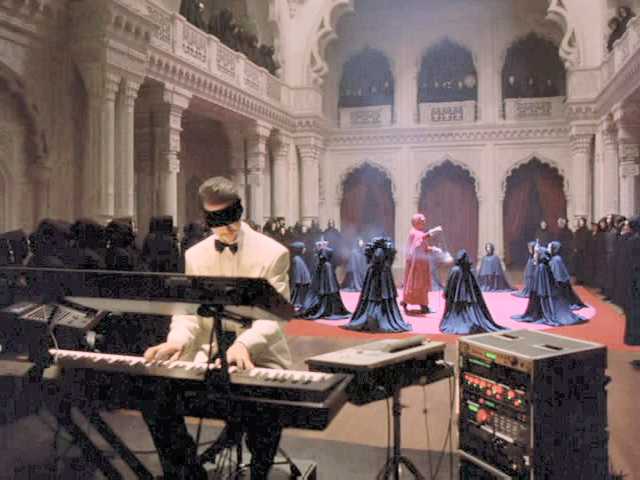
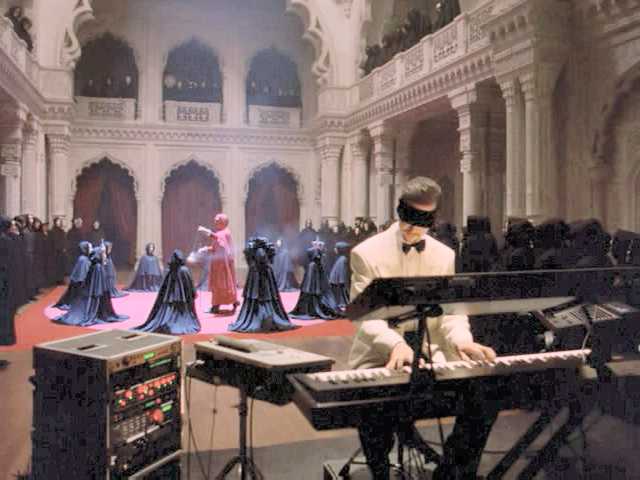
The name Pook refers to Jocelyn Pook, who can be traced to an album named "Flood" released in 1999. Pook is a contemporary classical composer and violinist who divides her time between avant garde scores and pop collaborations. Track 6 of the "Flood" CD is the composition "Masked Ball" used by Kubrick in Eyes Wide Shut's beginning of the orgy scene. It is 6:09 minute in length. So here it is, check it out and come back to this page... to read on...

Abracadabra-65a

At the request of Kubrick, Pook adapted her earlier work named "Backwards Priests" to produce "Masked Ball" in which the chanting heard is the sound track of Romanian priest chanting played backwards.

You can imagine that this is going to require serious technical work to get to the bottom of all this intriguing behind the scene secrets. First, how do you play a sound track backwards? Hmmmm... This is not rocket science, so after a few waves of my magic wand, I listen to the entire 6:09 minutes of the secret sound track, but it was no real big help! What are they talking (chanting) about??? It turned out that I am not the only person trying to decipher this mystery and I found some discussions giving away the answers to the Romanian chant of priests. As it is cruel for me to leave you in the dark, here it is, fully explained...

The chant is Romanian, and plus or minus a few typos/errors, it says:

"Zisa Domnului catre ucenicii sai...Porunca noua dau voua...

Domnului sa ne rugam pentru mila, viata, pacea, sanatatea, mantuirea, cercetarea, lasarea si iertarea pacatelor robilor lui Dumnezeu. Inchinatori, miluitori si binefacatori ai sfantului lacasului acestuia."

In the reversed video below, you can hear the chant reciting the words above. The first phrase is chanted in the lower tone, loosely translated as...

"And God told to his apprentices...I gave you a comand..."

This phrase is repeated several times during the 6:09 minutes which ended with a final repetition 8 times in solo. In four instances, this short and repetitive chant is accompanied by the higher pitch voice chanting the second part that says...

"Pray to the Lord for the mercy, life, peace, health, salvation, the search, the leave and the forgiveness of the sins of God's children. The ones that pray, they have mercy and they take good care of this holy place."

which was repeated a total of 4 times during the segment.

And here it is... This one opens a new window so you can hear the chant and read the text on this page at the same time. You will need to allow new window to pop up, a small price to pay.

Abracadabra-65b

Evidently, this is one of the movies that you can only appreciate by multiple viewings. My favorite clip? Since you asked, take a peek...

Abracadabra-65c

Can you SEE while your eyes are wide shut? Be patient! Wait! Is the screen really black? Are you sure? Keep your Eyes Wide Shut, you'll see!

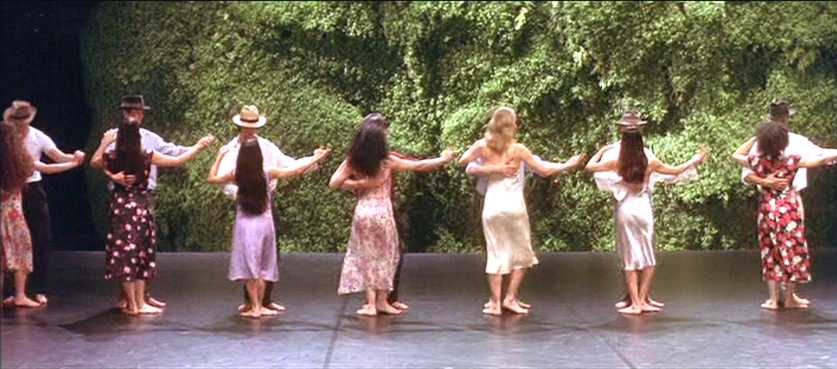
The music you hear is used at the beginning and at the end of the movie: Waltz 2 by Dmitri Shostakovich's Suite for Variety Stage Orchestra, which is one of the two main themes selected by Kubrick. Georgeous.

Friday, January 19, 2007

Monday, December 18, 2006

Sunday, December 17, 2006

Crazy Lovable French

After rewatching the insane kamikaze car drive clip, I was so intrigued I could not keep it off my mind. Determined to get to know more details, I hunted for and found the interview of Claude Lelouch. Unfortunately, it's in French and needs to be translated for you to follow. Reading his narration of the drive, I realized this is deja-vu for me. I've done something like this before although not as crazy as in this event. Of course, most French men behaved this way when they found themselves behind the steering wheels of their cars: they always "floor it!" Just like Lelouch did: "pied au plancher" as he said it. His car's speedometer was "bloqué à cent quatre-vingts" which means his car was going as fast as possible at top speed of 180 Km/hour, about 110 MPH. But there is more to this story...

110 MPH is not so fast with today's standard, but in the 70's that was quite fast. What was really insane, and in French, it's called driving "a tombeau ouvert" meaning driving at "open coffin" speed, was that he did in Paris! That was crazy, driving like that in the streets in Paris. So it became intensely interesting for me to find out the route he took and especially how that was planned and carried out. He was crazy, but not stupid, so he chose to do the stunt in August, at 5:30 AM so traffic should be light. He started from "Porte Dauphine" and drove across Paris to the North East corner of "Place du Tertre" near Montmartre where you find the world famous "Sacre Coeur" church. To appreciate the craziness, you need to look at the street map of Paris, here the great on line Google map is used:

Porte Dauphine

He started at the "Porte Dauphine", at the left edge of this first map and remember he was "flooring" his car all the time, 150 - 180 km/h (to get km/h to MPH, divide by 1.6) on avenue Foch to Place de l'Etoile where you see the "Arc de Triomphe." Then he hooked a slight right to maintain high speed of 130 -150 km/h down "Avenue des Champs Elysees" to the "Place de la Concorde" reaching 200 km/h, negotiated it at 150 km/h and proceeded to "Quai des Tuileries" along the right side of the river "Seine" on the next map:

Louvre

This is where he pointed out during the interview the most dangerous place for this kamikaze drive: at the Louvre museum, called "les guichets du Louvre." If you ask me, I will tell you it is insane the entire drive, from start to finish! So, watch the clip again, imagine you are behind the steering wheel. Another car can come out of nowhere and you will have to react at that speed, while your right foot was "on the floor!" Crazy pure and simple! And he knew it!

He said that after the Louvre museum, it was smooth sailing. Not quite! After passing the "Opera", he proceeded North to Trinite which is seen at the lower left on the next map. From there, he needed to proceed to "la place du Tertre" where I placed a "Red Heart" to mark the place of the Rendez-Vous on the map for you:

Rendez-Vous

It doesn't matter which route he took, most of the Paris streets are tiny cobble-stoned streets to where the "heart" is. There are no straight streets to Montparnasse/place du Tertre! Now, watch the clip again to really appreciate what you are witnessing: real life macho driving, no tricks, no stunts! You can see the streets he mentioned in the interview: rue Lapic, Boulevard de Rochechouart ... A few times, he had to go the "wrong way" to avoid obstruction by a bus, a garbage, and a delivery truck.

In a nutshell, he valued punctuality, and had the idea of making a movie about a guy not wanting to be late to the rendez-vous with his girl, speeds through traffic to her. After the filming of his latest film, he had left over film material one of which was for about ten minutes worth, so he decided to realize his dream clip. There was no way to block Paris traffic for the entire shooting take so he did it without. After consulting with a stunt driver about the risks, he decided to take them, mapping out two major technical difficulties: the timing for the girl to greet him at arrival and the dangerous blind spot at the Louvre museum. The entire thing must be done only once, under 10 minutes before the film runs out, and there will be no reshoot! He had planned for a watch out assistant at the Louvre to warn him of incoming traffic but the walkie talkie did not work. He didn't know it until after all was said and done. He took risks, and got this clip for his movie fans. Amazing! That is why this work was very much sought after over the years. By the way, he could not afford to stop at traffic lights because these stops will destroy his film, and he would never have made it in time. Count them, the drive ignored 18 red lights, no less!

Below is a recount of reports of interviews of Claude Lelouch in French posted on his web site here

Go to this link:

here

Scroll at the film icons at the bottom to select that of "C'Etait Un Rendez-Vous" to see the first narration by

Lelouch:

------------------------------
Visa n° 46 452
Durée : 9 minutes
© 1976 Les Films 13

Un plan-séquence de 9 minutes. La traversée de Paris en voiture. Un film culte !

Disponible en bonus sur le coffret DVD "Claude Lelouch, Les Géants du cinéma, volume 1".

Claude Lelouch parle du film :

"Je roule comme Trintignant dans "Un Homme et une Femme", pied au plancher, compteur bloqué à cent quatre-vingts, prenant tous les risques. Et même d'avantage, puisque je ne suis pas au rallye de Monte-Carlo, mais en plein Paris. A côté de moi, mon chef opérateur contrôle la vitesse de la caméra accrochée au pare-chocs. Nous brûlons systématiquement tous les feux rouges. Les rues et les avenues défilent à une vitesse terrifiante.

A ce moment là, je me dis que les spectateurs seront collés à leurs fauteuils, écrasant du pied un frein imaginaire. Car c'est un film, bien sûr, que je tourne. Neuf minutes trente secondes. Neuf minutes trente secondes de pellicule, c'est ce qui me restait à la fin du tournage de "Si c'était à refaire", au moment des rendus. Trouvant dommage de laisser perdre ces précieux trois cents mètres de pellicule, j'en ai profité pour réaliser un projet qui me tenait à cœur depuis longtemps : un film en un seul plan-séquence où la caméra traverserait Paris à grande vitesse, son regard étant celui d'un homme qui conduit comme un fou parce qu'il est en retard à un rendez-vous.J'avais eu cette idée un jour où, moi qui suit toujours ponctuel, j'étais dans la même situation. Comme il était vital que j'arrive à l'heure, j'ai traversé Paris à une vitesse hallucinante, brûlant des feux rouges, empruntant des sens interdits, prenant des risques insensés. Comme je suis entrain de le faire en ce moment même. Cinq cent soixante-dix secondes, pas une de plus, c'est le temps que j'ai pour effectuer le trajet porte Dauphine-place du Tertre. Avec deux principaux problèmes techniques. Le premier consiste à coordonner le parcours de la voiture avec l'action des dix dernières secondes, quand Gunilla, ma compagne de l'époque (qui est aussi la mère de ma fille Sarah) s'avancera vers le véhicule qui s'arrêtera devant elle. C'est le bruit du moteur, à mon approche de la place du Tertre, qui l'avertira qu'il est temps de s'avancer jusque dans le champs de la caméra. Le second problème réside dans l'impossibilité d'assurer la sécurité de l'opération. J'ai limité les risques en tournant ce film cascade au mois d'août, à cinq heures trente du matin, au lever du jour. La circulation est donc quasiment inexistante. Je n'ai pu cependant obtenir l'autorisation de bloquer les rues débouchant sur mon parcours. Un véhicule peut donc déboîter devant moi à n'importe quel moment. Ci cela se produit, je prie pour avoir le coup d'œil et les réflexes nécessaires pour réagir au quart de seconde. L'étape la plus dangereuse du parcours demeure le passage des guichets du louvre. Il n'y a aucune visibilité à la sortie. Si une voiture surgit à ce moment devant mon capot, la collision sera inévitable. J'ai donc posté mon assistant, Elie Chouraqui, à cet endroit stratégique. Grâce à son talkie-walkie, il me parviendra en cas de danger. J'arrive à la hauteur des guichets du Louvre. Aucun signal de la part de "Chouchou". Je fonce. Le reste du parcours s'accomplit sans problème. Je ralentis place du Tertre, et Gunilla, avec un chronométrage parfait, s'avance à ma rencontre. Un quart d'heure plus tard, je retrouve Chouraqui, en train de bricoler son "talkie".

- Qu'est ce qui se passe ?
- C'est cette saloperie ! me dit-il en désignant l'appareil. Il est tombé en panne au début de la prise !

J'ai un grand frisson d'angoisse rétrospectif.

Debout dans le bureau du préfet de police, j'ai la sensation d'être un enfant puni. Je m'apprête d'ailleurs à l'être et sévèrement.D'une voix de procureur, le préfet, qui m'a personnellement convoqué, dresse à mon intention la liste de toutes les infractions que j'ai commises pendant les quelques minutes de tournage de "Pour un rendez-vous". Elle est interminable. Quand il a fini, il lève sur moi un oeil noir et dit en avançant la main :

- Remettez-moi votre permis de conduire, s'il vous plait. Le moment serait mal choisi pour discuter. Je m'exécute. Le préfet de police s'empare du document, le contemple rêveusement pendant quelques secondes, puis... me le rend avec un large sourire.
- Je m'étais engagé à vous le retirer, me dit-il. Mais je n'ai pas précisé pour combien de temps.

Devant ma stupéfaction, il ajoute :
- Mes enfants adorent votre petit film !"

Claude Lelouch

C'ETAIT UN RENDEZ-VOUS

------------------------------

You can read the transcript of the interview
here

Scrool down and click on the link ["C'était un rendez-vous" toujours culte ! (20/03/2006)]

here

-----------------------------------
"C'était un rendez-vous" toujours culte !
20 mars 2006

"C'était un Rendez-Vous", court métrage réalisé en 1976 en plan séquence par Claude Lelouch, parait susciter de très nombreuses interrogations suite à la diffusion grandissante du film sur le net, que certains d'entre vous découvrent et que d'autres redécouvrent avec plaisir …

Qui était au volant ? de quelle marque était la voiture ? les rues étaient-elles bloquées ? … En somme, comment a été préparé et dans quelles conditions le film a pu être réalisé... Voici les réponses à vos questions...

Préparation du célèbre plan-séquence...

Dans quelles circonstances avez-vous entrepris "C'était un rendez-vous" ?

Je venais d'achever le tournage de "Si c'était à refaire". Quand un film se termine, on effectue les "rendus". J'ai donc demandé à mon régisseur quel métrage de pellicule il nous restait. Après inventaire, nous avions pas mal de chutes, entre 3000 et 4000 mètres au total. Beaucoup de petits rouleaux de 30 ou 50 mètres, mais aussi un magasin de 300 mètres, qu'il était prévu de rendre. Moi, j'avais envie de faire un court métrage que nous aurions placé en première partie du film. Depuis longtemps je voulais raconter l'histoire d'un type en retard à un rendez vous qui commet plein d’infractions pour arriver à l’heure. Pour moi , être à l'heure est une obsession. Je suis capable de prendre des risques inouïs pour ne pas être en retard. J'ai suggéré à mon opérateur Jacques Lefrançois, l'idée d'un plan-séquence, la caméra accompagnant un type qui a rendez-vous à Montmartre avec une fille. Comme il est à la bourre, il traverse Paris à toute allure, en grillant les stops et les feux rouges.

Dans le film, le conducteur prend-il le chemin le plus direct ?

Si un Parisien veut aller de l'avenue Foch à Montmartre, il n'est pas obligé de passer par les guichets du Louvre...Il va prendre l'avenue de Wagram, bien sûr. Mais, Vous vous en doutez, je voulais en même temps proposer une sorte de reportage. Mon problème était d'élaborer un plan qui n'excède pas dix minutes et qui trouve son intérêt à la toute fin avec la fille qui arrive sur les marches.J'ai réfléchi au projet. J'ai demandé à Elie Chouraqui, mon assistant à l'époque, de voir quelles autorisations il nous faudrait obtenir. Nous nous sommes vite rendu compte qu'un plan comme celui-ci nécessitait de bloquer tout Paris. Ce n'était même pas la peine de demander nous n'étions pas prêts à mettre en Å“uvre les moyens d'un long métrage pour réaliser un court. J'ai interrogé un cascadeur : « Si je filme très tôt, qu'est-ce que je risque en grillant les feux rouges ? » Il m'a expliqué que c'était de deux choses l'une. En arrivant à un feu rouge, s'il n'y a personne dans le champ de vision, le risque n'est pas bien grand de passer en force : il faudrait qu'au même moment, un même cinglé déboule à la même vitesse. Et s'il y a quelqu’un dans le champ de vision, il est toujours possible de freiner. Je suis donc parti du postulat que si je roule vite et que je ne vois rien, c'est qu'il n'y a rien ... Le seul inconvénient majeure c'étaient les guichets du Louvre. Ils me faisaient peur à cause de leur absence de visibilité. Pour le tournage, j'ai demandé à Chouraqui de s'y installer avec un talkie-walkie et de me prévenir au moment où j'arrivais. S'il ne me disait rien, c'est que tout allait bien. C'est la seule véritable précaution que j'ai prise. Pour la beauté du film, il fallait vraiment que je ne m'arrête pas. Que je stoppe à un feu rouge, et le film disparaissait. Il y avait d'ailleurs neuf chances sur dix pour que nous n'arrivions pas au bout.

La caméra est fixée à la calandre de la Mercedes. Comment la voiture était-elle équipée ?

Nous avons accroché la caméra sur le pare-chocs de la voiture, une 6,9 litres Mercedes. A l'intérieur nous étions trois, attachés comme des mulets : moi-même au volant, mon chef machino, et mon chef opérateur pour éventuellement changer le diaphragme. Au dernier moment, il a fallu régler un diapo moyen. L'image devait être au ras du sol pour être encore plus spectaculaire. Nous sommes en plein mois d'août. Bien sûr, nous avions décidé de sacrifier le film et de tout arrêter au premier danger. Nous roulions vraiment vite.

Quand vous dites "Nous roulions vite" vous parlez de quelle vitesse ?

La montée de l'avenue Foch, entre 150 et 180 km/h. Les Champs-Élysées à 130 à 150 avec une pointe à 160 km/h au niveau de Franklin Roosevelt. Puis jusqu'à la Concorde, comme c'était bien dégagé, j'ai dû monter à 200 km/h. J'ai pris la place de la Concorde à 150. Sur les quais, j'ai franchi les 200 km/h. J'ai pris les guichets presque normalement, c'est-à-dire à 80 ou 90 km/h. Comme Chouraqui ne m'appelait pas, je suis passé sous les guichets à fond, 100 km/h, car le passage est tout de même assez étroit. Je ne savais pas que le talkie de Chouraqui était en panne ! Je ne l'ai su que le tournage terminé. Puis j'ai remonté l'avenue de l'Opéra. Le carrefour était bloqué par un bus. Pour éviter de ralentir, j'ai dû passer de l'autre côté de la chaussée, des voitures venant en sens inverse. Place de I'Opéra, pas de problème ! J'ai ensuite pris la rue de la Chaussée-d’Antin vers Clichy. Je suis tombé sur des camions-poubelles que je n'ai pu dépasser qu'en montant sur le trottoir. Je croyais ne plus avoir de problèmes. Mais en arrivant rue Lepic, j'ai été bloqué par un type qui livrait. J'ai pris de l'autre côté, vers le paumant Palace, en destruction à l'époque. J'ai remonté l'avenue Rochechouart, ce qui me rallongeait énormément. Je ne savais pas s'il allait me rester suffisamment de pellicule. J'ai donc pris des rues en sens unique pour arriver à Montmartre dans les temps ...

Vous aviez effectué des repérages ?

J'avais fait le parcours une fois, lentement, pour bien déterminer les passages. Je disposais de l'équivalent de 9-10 minutes de pellicule ! Il me restait 15 secondes pour couper le moteur descendre de voiture et prendre la fille dans mes bras. Nous avions convenu que lorsque je klaxonnerais elle monterait deux marches, pénétrant ainsi dans le champ. Le plan-séquence ne pouvait être réussi que sur ces dernières secondes. Je m'étais dit que si je ne réussissais pas la première prise, je ne recommencerais pas. Par superstition. Si le miracle devait avoir lieu, il aurait lieu ... Et il a eu lieu. En forçant quand même le destin, puisque nous avons grillé dix-huit feux rouges.

Comment expliquez-vous la notoriété de ce court métrage, qui est devenu un film culte, ce qui est plus que rare peur un film court...

J'ai montré le film un peu partout. Il n'a pas toujours été très bien accueilli compte tenu de son manque de sens civique flagrant, ce que je ne saurais contester. Mais il a aussi ses fana. Quand j'ai montré le film pour la première fois à Los Angeles, où le non-respect des règles de conduite est toujours fortement sanctionné, le triomphe s'est mêlé à d'incroyables sifflets. "C'était un rendez-vous" a toujours suscité la polémique, mais il montre aussi tout ce qu'on aime dans le cinéma. Comme j'aime le cinéma plus que la loi ... Je savais que je tenais un morceau de bravoure. Je me disais, en toute modestie, qu'il y avait là la possibilité de faire l'un des plus beaux plans de l'histoire du cinéma. Les plans-séquences de dix minutes sont rares, en raison de l'étroitesse du magasin de la caméra. Même Hitchcock dans "La Corde" a anticipé ses changements de pellicule.

Vous avez repris ce principe de courses sous différentes formes.

Dans "Un homme et une femme : vingt ans déjà" , mais c'était sur un circuit, tout comme dans "Partir Revenir". Pour "Le Chat et la Souris", réalisé quelque temps plus tôt, nous avions expérimenté la chose. Mais le tournage était bétonné avec des flics devant et derrière. Pour "C'était un rendez-vous", nous avons fait un truc de voyou.

Qu'est-ce que vous risquiez ?

D'abord, un accident ! Ensuite, les conséquences d'un tournage sans autorisation. Enfin un retrait de permis de conduire. Le film est beau par sa prise de risque. S'il a eu autant de succès et qu'il prête tant à discussion, c'est qu'il est risqué.

Vous aimez les courts métrages ?

D'une certaine façon, il est plus difficile de faire un court qu'un long. Economiquement c'est un cauchemar. Artistiquement, il faut être dans l'essentiel. Quand on regarde un court métrage, on sait tout de suite si son signataire a de l'avenir dans le cinéma. Quand j'ai vu le court métrage de Xavier Giannoli par exemple, j'ai su qu'il s'agissait d'un vrai metteur en scène.

Entretien réalisé par
Yves Alion et Jean Ollé-Laprune
pour le livre "Claude Lelouch, mode d'emploi"
------------------------------------
Saturday, December 16, 2006

Oh La La!

The urban legend had it that...

"1978, French filmmaker Claude Lelouch mounted a gyro-stabilized camera to the bumper of a Ferrari 275 GTB and had a Formula 1 racer drive it at breakneck speed through the heart of Paris, reaching speeds of nearly 140 MPH (225 Km/h)."

The following clip is a mini movie (that even received an award) made actually in 1976 by a well known French movie director, Claude Lelouch:

C'était un rendez-vous (1976)

* The film was shot in a single take, without any special effects or stuntmen, with the director driving the car.

* The idea for this film came to Claude Lelouch after hiring a gyro stabilized camera mount for a film he was working on at the time.

* The film is nine minutes long because the film cartridge in the camera could only hold 10 minutes of film and it was taken in a single shot.

Over the years, various sources claimed an F1 formula driver was at the wheel of a Le Mans Matra 675, Ferrari 275 GTB, or an Alpine A110. However, Claude Lelouch confirmed on his official website in March 2006 that it was he who was driving, and it was a 6.9 litre Mercedes. Later the sound of a Ferrari 275GTB was dubbed over to give the impression of much higher speeds, that of a Ferrari.

The route taken in the film is 10.42 km long (6.48 mi). It takes the driver 7:57 to cover that distance, giving him an average speed of 78.64 km/h (48.86 mph). Calculations made by several independent groups using the film show that the car never exceeds 140 km/h (85 mph.)

Lelouch was arrested shortly after the film was screened but was later released without charge. It helps to be a well known celebrity anywhere.

The above information came from a well known internet movie database, and the entire movie clip came from here

The movie is available on DVD and can only be obtained here

Here it is. If you know Paris, you can easily recognize its famous landmarks.

Abracadabra-75.

Enormous Schwanstugel!

Abracadabra-76.

Friday, December 15, 2006

Heeeere's Johnny!

"R" rated! Very Intense! Not for the faint of heart! View at your own risk!

Abracadabra-77.

Time To Die

Abracadabra-78.

Sunday, December 10, 2006

Saturday, December 09, 2006

Nude Madreselva

This clip was done a long time ago. A newer clip that is longer with subtitle gives you a better glimpse of this movie. It is here.
Nude Masdreselva

Monday, December 04, 2006

Orpheus & Eurydice

This has been revised on Aug 26, 2011 to add the lyrics of the song sung by Orpheus, which is Manhã de carnaval. Music by Luis Bonfá and Brazilian Portuguese lyrics by Antônio Maria:

First, if you are interested in the original sound track, click on the MP3 player below. The lyrics you hear is different than the verse used by Orpheus that you will hear later in the video clip:

This is the original sound track of Manha de Carnaval, and its lyrics is below:

Manha, tao bonita manha..... Morning, such a nice morning!
De um dia feliz che chegou!..... Of a happy day that has begun!
O sol no ceu surgiu..... The sun has risen into the sky
E em cada cor brilhou..... And shone in every heart.
Voltou o sonho entao..... Then dreams have returned
Ao coraçao..... To the heart.

Depois deste dia feliz,.... After this happy day.
Nao sei se outro dia virá,..... I don’t know if another day will come,
E nossa amanha,..... And our tomorrow,
Tao bela afinal amanha..... After all such a beautiful tomorrow
De carnaval..... Of carnival.

Canta o meu coraçao..... My heart sings.
Alegria voltou. Tao feliz..... Joy has returned. So happy
A manha deste amor..... The morning of this love!


In the video clip, the lyrics is different:

Manhã tão bonita manhã!..... Morning, such a nice morning!
Na vida uma nova canção,..... In life there’s a new song,
Cantando só teus olhos,..... Singing only of your eyes,
teu riso, e tuas mãos,..... your smile and your hands,
Pois há de haver um dia,..... For there has to be a day
em que virás..... When you come.

Das cordas, do meu violão..... From the strings of my guitar,
que só teu amor procurou..... Which seek only your love,
Vem uma voz,..... Comes a voice to speak,
falar dos beijos,..... Of the kisses lost,
perdidos nos lábios teus..... In your lips.

Canta o meu coração,..... My heart sings,
alegria voltou, tão feliz,..... Joy has returned. So happy,
na manhã deste amor..... The morning of this love!
Black Orpheus

A new blog of this movie that has the second famous song Felicidade is dated August 26, 2011, here.

Jack Rabbit Slim's

Jack Rabbit Slim's

The Producers

This stream is damaged... need fixing...

The Producers

Battle Of The Bands

This stream is damaged... need fixing...

Battle Of The Bands

Bill Kills

This stream is damaged... need fixing...

Bill Kills

Oceanic Funeral

This stream is damaged... need fixing... Replaced by this.

Oceanic Funeral

Operatic Divas

This stream is damaged... need fixing...

Operatic Divas

Glass Symphony

This stream is damaged... need fixing...
Use this to view.
Glass Symphony

Saturday, December 02, 2006

Amarcord

This stream is damaged... need fixing...
Use this link to view the replacement.

Amarcord

Friday, December 01, 2006

Malaguena Salerosa

This stream is damaged... need fixing...

Malaguena Salerosa

Thursday, November 30, 2006

Buzz buzz....


I have a headache! Mind you, I am not trying to figure out what is the meaning of life, nor am I pondering about the profound fact of whether life is worth living. I just bought a book for that question, not that I expect to find the answer there but no doubt I will read it because I was out US $15 paying for it.

No, I have a headache because of bees. No, more precisely, because of what I learned about bees from the news! I was forced to think so hard about these bees, my head hurts all morning even today. "New homeland security buzz: Bomb-sniffing bees" was the headline of a news article posted on line two days ago. That sure got my attention. The story highlights were:

• Scientists train honeybees to sniff out explosives from dynamite to C4
• Researchers say bees could spot car bombs, IEDs, suicide bombers' belts
• When a bee finds explosives, it sticks out proboscis, the tube it uses to sip nectar
• Similar research done with wasps in past, but scientists say bees do better

Hmmm... I don't know about you, but I was quite curious about this and wanted to know more. So what was the buzz all about?

After digging a bit more about this intrigue, my old memory rushed back with a vengeance. This is the kind of research I used to be involved with, not the exact same kind, but having the same flavor, that was being sponsored by a mighty US federal government that controls a huge annual budget that can be renewed yearly with ease. In particular, part of this bee research was/is sponsored by a famed branch of federal research agency named Defense Advanced Research Project Agency (DARPA.) Trust me, if you have any most outlandish, never heard of, out of this world, weird, inconceivable, unbelievable, far fetched idea to promote, you probably have a very good chance to get funding from DARPA. I know, I've been there, done that. I am not talking about chicken feed here. I am talking about BIG BUCKS, with lots of zeros in the check you'd receive monthly to do the proposed research. The kind I did was too embarassing to recount so I will spare you, and especially myself the embarassment for the explanation. So, let's just get to the honey bees.

As it is now the in thing in the US: preoccupation with terrorism and the like, it is not surprising to see this news coming from a prominent US weapons laboratory. With the aid of DARPA, this laboratory worked hard to train bees to sniff out explosives. Although I am not privy to the original proposal for this research, I am sure it contained something like this "This project could have far-reaching applications for U.S. homeland security and the Iraq war."


Here is an excerpt from the news article, used here in the context of "fair use" so I do not have to ask permission for reproduction:

"Researchers at the Los Alamos National Laboratory in New Mexico said they trained honeybees to stick out their proboscis -- the tube they use to feed on nectar -- when they smell explosives in anything from cars and roadside bombs to belts similar to those used by suicide bombers. The results of this Stealthy Insect Sensor Project was published a few days ago, on November 27, 2006.

By exposing the insects to the odor of explosives followed by a sugar water reward, researchers said they trained bees to recognize substances ranging from dynamite and C-4 plastic explosives to the Howitzer propellant grains used in improvised explosive devices in Iraq.

"When bees detect the presence of explosives, they simply stick their proboscis out," said one of the research scientist of the lab who is the project's PI (principal investigator.) These findings followed 18 months of research at the U.S. Energy Department's Los Alamos facility, the nation's leading nuclear weapons laboratory.

They said the bees could be carried in hand-held detectors the size of a shoe box, and could be used to sniff out explosives in airports, roadside security checks, or even placed in robot bomb disposal equipment; and that the next step would be to manufacture the bee boxes and train security guards in their use."

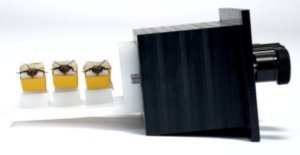
Lo and behold, I found another company (http://www.inscentinel.com) that seemingly is in a more advanced state of affair. It is not American, but British! I am quite surprised to see that these two works do not reference each other. Apparently, the British company already has a prototype called "vapour detection instrumentation" that holds trained bees in a "safe" and "controlled" environment, which can be operated in a range of external environmental conditions. Sample air is delivered to the bees for recognition of specific odours. The bees are held in a special cassette and specially designed hardware and image recognition software monitors and records detection by the bees, converting their response into an electronic form. The electronic output can be given in a simple yes/no, green light/red light form.


From this small image, I hope you can see, so you can commiserate, how the bees are being treated! This seems to be worse than the French's cruel and unusually harsh treatment of geese for their "foie gras," or that of the veals. Although I did not spend anytime looking into this, I am sure that the recognition software they talk about is to catch the bees when they stick out their tongues.

I remain very skeptical about all this, knowing how DARPA works, so I did what came naturally, buzzing around the internet and look what I found in 2 minutes...

http://jeb.biologists.org/ which publishes on line articles from "The Journal of Experimental Biology." This is a LARGE organization with scientists from various countries such as Switzerland, Canada, the UK etc... so I think what they say may be very believable, and what one of their research project says is this: "FRUIT FLIES STICK OUT TONGUE TO BREATHE."

This study was about the question whether small insects like fruit flies, bees etc... breathe (or ventilate, speaking scientifically) and if they do, how. Its conclusion is that they do breathe, by sticking out their tongues, using them as pumps.

To me, this casts a giant shadow on the bee research. Could it be that these poor bees, when exposing to weird air environment, were simply suffocated and they were trying their best to BREATHE? If I were one of these bees inside my box at an airport, and they stick some shoes from some guys up my nose, I will stick out my tongue and that is no explosive that I smelled!

I am going back to my research mode and submit a new proposal to DARPA. Stay tuned as I will publish my research results here!

Wednesday, November 15, 2006

I am so lonesome I could cry!

Some poets wonder if rocks feel pain. They think so especially when they are love sick and tend to project their suffering onto inanimate objects in hope that these objects somehow help shouldering their sorrow. Now, that is an obtuse way for me to justify the several hours spent last Wednesday, November 8, 2006 participating passively in the celebration of a rare celestial event: the transit of the planet Mercury. If you read on, you may see the connection.

In case you do not already know, Mercury transit is a real physical astronomical event, and not some bus or subway train in some city of some country in this world. If you remember the early days of your life when you were in grade school, you will recall that we live in the so-called Solar system, and we are "the third rock" from the sun. There are two more rocks, Mercury and Venus that orbit closer to the sun than our earth. For this reason, once in a while, sometime a long while, from earth, either Venus or Mercury can be seen streaking across the surface of the sun. That is called a transit. Last week, on November 8, the planet Mercury did just that.

Thanks to human's ability to perform complex mathematical calculations, we know when these events occur and where to look so we are always prepared to witness them in action.

Mercury transit is a BIG deal. Every astronomer in the world has prepared for this event for months and they were all ready last week. The last transit was on May 7, 2003 and the next one will not occur until May 2016. This year, the year 2006, a live webcast from Kitt Peak National Observatory's exploratorium was set up to let the world participate in this event. Of course, I took some time off my busy schedule of doing mostly nothing to watch this rare event. The webcast used a Mead 16" telescope with special solar filter as a main tool but it had two other telescopes with different viewing equipment.

Watching the sun is never an easy task. I remember as a kid, I was taught to watch solar eclipses by looking at a dimmed reflection from a bucket of water, or through a piece of exposed film. Nowadays, the world has grown much more sophisticated and we have more gadgets to fit our fancies to do these things. I do have a telescope, but not about to deploy it for this event because without special solar filtering equipment, I do not think my retinas will survive the ordeal. So the webcast was such a nice gift. Thank you, Kitt Peak observatory! Knowing this being a LONG event, I was prepared for a planned 5 hour+ session. Here is the story book:


Mercury Transit


As way of background, the time is UT ("Universal time") or GMT ("Greenwich Mean Time") which is five hours ahead of Eastern Standard Time (EST) for people who live in the Eastern seaboard of the US like myself. As seen here,

Mercury Transit

not everyone on earth could see the transit the same way. Most of the area surrounding the continent of Africa could not see it at all. Australia and Western Pacific saw the transit at sunrise while most of North and South America could view a portion of the transit during sunset. Kitt Peak was ideally positioned to see this Mercury transit in all its entirety.

The webcast was ably commented by expert astronomers who took turns explaining what was being shown. Even these seasoned professionals got all excited when the planet Mercury started its trajectory across the surface of the sun, called first, second third and fourth contacts. Three telescopes were fitted to display views of the sun in white light with orange filter, in hydrogen alpha visible light and in excited calcium wave length. Needless to say, all images seen during the webcast were excellent, one of which appeared like this:

Mercury Transit

Truthfully, after about an hour, the webcast looked pretty boring because all you see was a round dot inside an orange square. Every now and then, the experts would come back on line to engage the viewers. At one time, they gave a tour of the edge of the sun, which was great because I do not think you can get that kind of tour from any travel agency on earth. I went for the distance and stayed with the webcast until the bitter end when it signed off, after Mercury finished its final fourth contact, egressing the surface of the sun and bid it goodbye until the year 2016.

OK. So, how was it, you ask? Was it time well spent or a total waste of 5 hours plus? What's the point in all this? If you revisit one of my previous blogs, on September 17 of this year, you can watch a pool table trick shot. If you understand French, you may hear a comment by a woman spectator: "... the exhibition serves no purpose and it is an unbelievable waste of time," to which there are some potent male chauvinistic replies from the French men that will not be repeated here. So, the answer is "beauty is in the eye of the beholder," which on its own merit can be subject of another blog. I may do that in the future, who knows?

Scientifically speaking, many experiments were being conducted during the transit because it offered unique opportunites to use the sun as a backgroud that aids in the study, for example, of Mercury's sodium content in its atmosphere that is not possible otherwise. You didn't know that Mercury has an atmosphere, did you? See? Time NOT wasted!

Me? I have a totally different take. I felt so sorry for our poor planet Mercury watching its transit. Undoubtedly, many times in one's lifetime, one cannot help but to feel lonesome to some degree. Such potentially devastating condition of the human mind can be detected in many well known literary authors as reflected in their books, theatrical plays, movies and other art forms. One famous such work was a song written in 1949 by Hank Williams, bearing the same name as the title of this blog. If you listen to the rendition of that song by country singer Johnny Cash, you probably would want to die. If you think that human loneliness is bad, think about the poor planets in our poor solar system that includes our own poor earth. We are all but a collective mass of matter destined to wander eternally without hope of escape in the boundless, empty, cold and dark void of the universe until death dawns. The fact that we are a thinking species makes it much worse. Can we be better off being just rocks? Are we sure rocks do not feel pain?

So, please take a look at a composite of the now history Mercury transit that lasted 5 hours +:

.Mercury Transit

That is a LONELY trek that repeats for an eternity. How sad! Now that you can see it, perhaps you can feel it!

Tuesday, October 31, 2006

Gravity pulls!

Before the ink on my last blog dried, I received a new suggestion for a superior selection of a choice spot for "the mother of all free falls:" the Glass Bridge, also known as the Skywalk. This is supposed to be on a site within the US' Grand Canyon, looking down on the Colorado river.

To be fair, know that this is a new project under construction that has suffered some setbacks and it is slated for a grand opening toward the end of the year 2006. Mark your calendar and get your airline ticket if you want to be the first in line for a spungy jump. However, remember that the pictures you see below are "artist's rendering" of a "soon to be built" structure. Let's hope they do not run out of cash in the middle of the construction that is taking place right at this moment.

Of course, I cannot let this candidate off the list I already cited in my previous blog, so here it is:


You can see in the insert that a jump from this beauty easily dwarfs all that from the top of all the known skyscrapers of the world. To scale, the US' Empire State Building on the left is seen with its puny 1,252 feet. To the right is the tallest building in the world, Taipei 101, towering at a mere 1,671 feet. But look at this:


Do you see the tiny Colorado river below? You think you can hit it? Or will you miss it? Did you consider wind shear? Now, a new calculation is in order. It will take you a LONG, LONG, LONG 15.6 second to cover the whopping 4,000 feet of height. By the time you reach your destination, you should be traveling at the speed of 350 miles per hour. Thankfully, we are on earth, and the precious air we use to breathe slows you down to about a mere 130 miles per hour or so, depending on your weight and a few other physical constants contained in the consideration paid to what physics calls "terminal velocity." That hurts!

Do you know what I think? This structure is catered for insane people! It has a glass bottom, sticks out 70 feet into nothingness, you have to pay to be scared to death stepping on the glass bottom cantilever with no cable support from above or beam support from below. Make sure you do not wear your hat on a windy day and hang on dearly to the glass side rail!

A positive final departing note: I am sure that the mere fact of taking one step out on this structure and look down once will be enough to erase all dark thoughts from your mind. Suddenly, you will think that life is so beautiful and please, please, please, let me get back to the safety of the rock side. What was I thinking?

Sunday, October 29, 2006

M*A*S*H 1977

The final splash!

I do not really know why people get more depressed at the approach of holidays in the US. I am not even sure if this is true worldwide, and would be amazed if that is so. In any case, so called US experts would assert they know all the reasons behind this perceived trend which they name SAD for "seasonal affective disorder." Very appropriately, a documentary movie is recently released named "The Bridge." This documentary film deals with the most popular suicide destination in the world, the Golden Gate Bridge in San Francisco, USA. After learning about this film, my memory flashes back several decades to my youth from which I can recall vividly one question I had to which I did not readily have answers at that time. I know I can dive from a diving platform into a swimming pool. The question was: can I dive into an ocean from a very high altitude (like jumping off an airplane) to gracefully split the water to win a gold medal as the world's best Olympic diver? According to "The Bridge:" No! Over my dead body! Actually, that's what the San Francisco Golden Gate Bridge is famous for: that's how you commit suicide, jump off that bridge.

You see, it's all in the physics of how things go in this universe. Curiously, it involves the second law of thermodynamics and Shakespear, but I am in a mellow mood now and will spare you that highly philosophical tirade. Let's talk low order physics:

From the bridge escarpment, you are about 250 feet above the ocean surface below. From elementary Newton's calculation, it takes you a mere 4 seconds to free fall and reach the water with a velocity of about 90 miles per hour. On reaching the surface of the water, unfortunately, you carry with you a lot of baggage: your kinetic energy! By the law of conservation of energy and momentum etc... regardless of how your body meets the water molecules, this energy is converted to other forms such as heat and forces that want to interact with every molecules of your body, some of which are your skull, your femur, fibula, tibia, humerus, radius, ulna, clavical etc...

Although your bones are hard as steel, they are no match! There are fascinating engineering studies of how the 206 bones in a human boby break under the stress of stretching, compression, torsion etc... the bottom line is, under appropriate stress, they all break. At 90 miles per hour impacting the water molecules, many of the bones will break, leaving the internal organs exposed to the environment. The bottom line is

“jumps from higher than . . . 250 feet over water are almost always fatal.”

"Jumpers who hit the water do so with a force of about fifteen thousand pounds per square inch. Eighty-five per cent of them suffer broken ribs, which rip inward and tear through the spleen, the lungs, and the heart. Vertebrae snap, and the liver often ruptures."

The final splash!

Interestingly, it is not always fatal because some suiciders have second thought during that 4 seconds so they chose to go feet first and their skull may remain intact. With some cooperation from lady luck, they can survive to tell.

Below are two very interesting graphical representations of studies related to "The Bridge:"

The first one shows the distribution of the locations from which suiciders jumped off. They like the location of light pole numbered 69, facing the East side of the bridge, and at about mid-span.

The final splash!

The second graph shows the distribution of suiciders over the years since the bridge was first constructed in 1937. 1977 had the highest number of 40 persons jumping off the bridge. It is not clear how many survived, not too many.

The final splash!

And you know what? Take a look at that year, 1977, one of the most popular television shows was: "M*A*S*H" whose theme song was by Mike Altman and Johnny Mandel. Its title? "Suicide is Painless."

Through early morning fog I see
Visions of the things to be,
The pains that are withheld for me,
I realize and I can see...

That suicide is painless,
It brings on many changes
And I can take or leave it if I please.

The game of life is hard to play,
I'm going to loose it anyway,
The loosin' card I'll someday lay;
So this is all I have to say...

That suicide is painless,
It brings on many changes
And I can take or leave it if I please.

The only way to win is cheat
And lay it down before I'm beat
And to another give my seat
For that's the only painless feat.

That suicide is painless,
It brings on many changes
And I can take or leave it if I please.
And you can do the same thing if you please.

Copyright (C) 1970 by Twentieth Century-Fox Music Corporation,
8544 Sunset Blvd., Los Angeles, CA 90069
Twentieth Century-Fox Music Corp. Ltd., London W1, England
International Copyright Secured
Made in U.S.A.
All Rights Reserved
AJS

Not so, according to my analysis and recorded facts at "The Bridge."

Let's see, if things do not go so well, where else can one go? To start... The Empire State Building (102 floors, 1252 feet, 381 meters high,) the Duomo, St. Peter’s Basilica, Sydney Harbor Bridge and the eternal city of light with its Eiffel Tower! I am sure you do not want to see my analysis of how the Young Modulus of bones behave when bones hit the concrete.

Cheers! Don't be so gloomy, please!

Saturday, October 14, 2006

I am afraid, really really afraid...

Everytime I have the yen for a juicy barbeque steak (is this spelled right? barbeque??? need to check it out...) and prefer to have it done myself rather than to go to an expensive restaurant, I am faced with a mortal fear. So, today, I decide to get to the root of this mental block that has plagued me for as long as I can remember. Then, I need to look for a cure!

First order of business, scientifically speaking, is to analyze the situation and discover the roots of this problem. Roots? Looks like I need to dig!

Starting with just the letter "A," I can already think of at least 60 reasons contributing to my consternation, too numerous to tell you about all of them. Systematically though, I want to gather and list some of the possible causes that may contribute to my anguish:

Agliophobia or Algophobia are definitely suspect. And please, please, please, please do not confuse these with Agraphobia or Contreltophobia.

Now, Agrizoophobia is definitely in the hunt... although Aichmophobia comes close to being a possible candidate.

How about Amychophobia? Hhmmm, possible, possible!

Definitely, I need to consider Aphenphosmphobia but Apiphobia may be unfounded!

Are you ready to proceed to the letter "Z?"

Batrachophobia, Belonephobia, Blennophobia, Bufonophobia. Chiraptophobia, Cnidophobia (definitely, brrrr... this really, really scares me!)

Not to forget Doraphobia!

Enetophobia, Entomophobia, Haphephobia, Helminthophobia, Herpetophobia, Homichlophobia, Melissophobia, Microphobia, Molysmophobia, Mottephobia, Musophobia, Myrmecophobia, Myxophobia, Nosophobia, Odynophobia, especially Ophidiophobia!!!

Panthophobia, Parasitophobia, Pathophobia, Pediculophobia, Phobophobia, Phthiriophobia, Ranidaphobia, Scoleciphobia, Spermatophobia, Spheksophobia, Stenophobia, Suriphobia, Taeniophobia, Traumatophobia, Trypanophobia, Verminophobia
and finally, I know we eventually come to it... Zemmiphobia.

If you have not been able to figure out thus far what I am talking about beside the nebulous "obias," take a look at what I need to do! This is serious, and I am not talking about cleaning the cooking utensil! That's the easy part!

Who's lurking in here?

Once in a blue moon, I do get the urge to fire up my trusted 2 person BBQ and have a memorable cookout. I have all the tools and supplies conveniently tucked away inside my patio so it is a simple matter to start the process. However, to start, I need to get the charcoal out of the bag! This bag may have lingered outdoor for many moons and God only knows what may have transpired since it was last touched by a human. Now, how one would do this? What are the risks one encounters venturing one's hand inside this dark and forbidden space to retrieve the brickets? You know what I mean? What creature may be ambushing in there ready to strike without warning?

After seriously twisting my poor brain, here are a few possible cures, none of which I think will work:

1. Dump content by emptying into BBQ pit
2. Use long tongs to retrieve carbon brickets, one by one?
3. Use thick and heavy protecting gloves
4. Use transparent bag to contain charcoal.

It's a tough problem. 1 no doubt will give me a fit of C6FallingAllOverThePlacePhobia, 2 will trigger YouVeGotThreeOf42BricketAreWeThereYetPhobia, 3 WhereAreMyFingersThisWontWorkPhobia and 4 ItsAllBlackUCantSeeThruPhobia. Nah! I told you, none shall work!

I'll keep the status quo to enjoy the heart pounding adventures everytime I poke my hand in this unknown black hole. To be sure, I won't use my right hand. Wait a minute! I need to make sure I am not sinistral or southpaw, in which case I need to "not to use my left hand." One can never be too careful. Life is so stressful!

Sunday, September 17, 2006